By Rita Ngo | Vietnam Business & Visa Consultant
Most advice about freelancing in Vietnam treats it as a paperwork question. Which visa do I need? Where do I file?
That’s the wrong starting point.
The real question is classification. Before any paperwork, Vietnamese law needs to determine what you are: a visitor, a contractor, or an employee. Each category carries different obligations: on visa, work permit, tax, and contract structure. Get the classification wrong and the paperwork doesn’t fix it.
This page explains how that classification works, what’s changed in 2025 and 2026, and when legal consultation is actually necessary.
What “freelancing legally” means in Vietnam
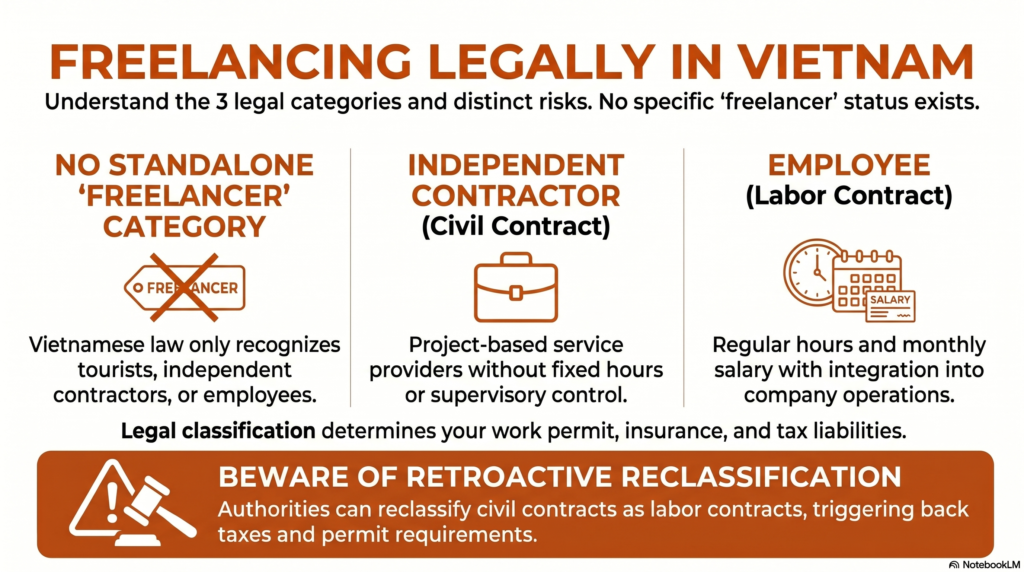
Vietnamese law doesn’t have a standalone category for freelancer. What it has are three distinct legal relationships:
Tourist or business visitor: entering the country temporarily, not generating income from Vietnamese entities.
Independent contractor: providing services under a civil contract (hợp đồng dân sự), project-based, without supervisory control or fixed hours.
Employee: working under a labor contract (hợp đồng lao động), with regular hours, monthly salary, and integration into a company’s operations.
The distinction matters because only the first two apply to most foreign freelancers. But courts and labor inspectors can reclassify a civil contract as a labor contract if the arrangement looks like employment. When that happens, work permit requirements, social insurance liabilities, and back taxes apply retroactively.
When you need a work permit and when you don’t
You likely don’t need a work permit if:
- All your clients are based outside Vietnam, you’re not receiving payment from a Vietnamese entity, and you stay fewer than 183 days per year in the country
- Your engagement qualifies under Decree 219/2025’s exemption categories (15 categories as of August 7, 2025), including capital contributors with VND 3 billion or more invested, board members of joint-stock companies, or workers on short-term engagements under 90 days annually
- You’re providing services to a foreign company through an internal transfer arrangement
You need a work permit if:
- You’re receiving payment from a Vietnamese company or individual for ongoing services
- Your freelance engagement has scheduled hours, reporting lines, or a scope that resembles permanent employment
- You’re staying more than three months and your work is connected to a Vietnamese entity
One threshold most people miss: 183 days per year is the tax residency trigger. Once you cross it, Vietnam taxes your worldwide income, not just income earned in the country. This applies even if your clients are entirely overseas.
If you’ve confirmed you need a work permit, the application process, exemption categories, and employer obligations are covered in detail here: Work Permit in Vietnam: The Complete Guide for Expats (2026)
If the 183-day threshold applies to you, Vietnam tax obligations for foreigners are more involved than most people expect. Rita works with a trusted local accounting firm to handle personal income tax declaration and filing on your behalf, covering both Vietnam-sourced and worldwide income where applicable. Full breakdown of what triggers tax residency and what it means in practice: Vietnam Tax Obligations for Foreigners
What changed in 2025 and 2026
Three decrees shifted the enforcement landscape significantly.
Decree 219/2025 (effective August 7, 2025) Expanded work permit exemptions from 9 to 15 categories. Cut permit processing from 20 working days to 10. Introduced a clearer 90-day short-term work rule for recognized experts. If you were previously told you needed a permit and couldn’t get one, it’s worth reassessing under the new exemption list.
Decree 282/2025 (effective December 15, 2025) Overstay fines more than doubled. Violations of 16 days or more now trigger deportation review automatically. Decree 282 also extended compliance obligations to hotels, employers, and any organization hosting foreign nationals, they can be penalized for failing to verify residence documents.
Decree 59/2026 (effective April 1, 2026) Created a comprehensive deportation procedure framework. Deportation is now faster and more procedurally defined. Authorities can deport immediately if fines cannot be paid; the fine is suspended, not cancelled. Foreign nationals subject to deportation receive written notice at least 48 hours in advance, but enforcement timelines are tighter than under previous rules.
Decision logic: which situation applies to you
If you work only for clients outside Vietnam and stay fewer than 183 days per year: Work permit is not required. Tourist visa or e-visa is sufficient for entry. No Vietnamese tax obligation on income. This is the clearest legal position for digital nomads with no Vietnam-based clients.
If you work only for clients outside Vietnam but stay more than 183 days per year: No work permit required, but you become a Vietnamese tax resident. Personal income tax applies to worldwide income. You need to understand your declaration obligations before the year ends.
If you work for Vietnamese clients under a civil contract: Civil contract is valid if it’s genuinely project-based, has a defined scope, and the client has no supervisory control over how you work. If the arrangement has evolved into something that looks like employment, the contract needs review before your next visa extension.
If you work for multiple Vietnamese companies: Vietnamese law requires a separate work permit for each employer unless an exemption applies. Working for multiple clients without individual permits is one of the most common compliance gaps.
If you want to set up a long-term legal structure in Vietnam: Some freelancers reach a point where the volume of local work makes a registered entity the more practical option. A foreign-owned LLC gives you a legal basis to invoice Vietnamese clients, hire staff, and operate without relying on civil contracts. It’s a different commitment level, but it resolves most of the classification uncertainty. The registration process, capital requirements, and timeline are covered here: How to Register a Company in Vietnam as a Foreign Investor (2026)
If your civil contract gets reclassified as a labor contract: Labor contract reclassification triggers work permit requirements, social insurance liabilities, and back taxes. Both the freelancer and the company face penalties. Reclassification risk increases with contract duration, regular reporting obligations, and fixed schedules.
If you’re working without a permit and get caught: The fine is VND 15–25 million (approximately USD 600–1,000) under Article 32, Clause 3 of Decree 12/2022. Deportation is mandatory under the same article. Blacklisting from future Vietnam entry is possible. The company that engaged you faces VND 30–75 million per infraction.
What this process doesn’t replace
A page like this can explain the categories and flag where problems commonly occur. It can’t replace the analysis of your specific contract, visa history, client relationships, and income sources.
Classification questions are fact-specific. Two people with identical visa types and similar work arrangements can land in different legal categories depending on how their contracts are written, who initiated the work relationship, and how payments are structured.
Rita Ngo’s consultation process looks at the full picture before recommending anything: visa status, contract structure, client location, length of stay, and whether any exemptions under Decree 219/2025 apply to your situation.
What Rita Ngo does not handle
This service doesn’t cover:
- Direct tax accounting or bookkeeping for personal income tax declaration and filing, Rita coordinates with a trusted local accounting firm and acts as the point of contact throughout the process. This is a managed referral, not a handoff. If you need this service, it can be arranged as part of the consultation.
- Cases where the person has already received a deportation order or is in active enforcement proceedings
- Work permit applications where the sponsoring employer doesn’t have a registered Vietnamese entity
Who this is for
Freelancers and remote workers in Vietnam who are uncertain whether their current setup is legal, particularly if they’ve been here for more than six months, have civil contracts with Vietnamese clients, or are about to sign a new engagement.
HR managers at Vietnamese companies who engage foreign freelancers and aren’t sure what their compliance obligations are under the new decrees.
Foreign professionals considering Vietnam as a long-term base who want to understand their options before committing to a specific visa or contract structure.
Who this is not for
People looking for a way to continue working on a tourist visa with Vietnamese clients. There is no legal path for that arrangement, and the consultation won’t find one.
People who need a work permit sponsored by an employer they haven’t yet identified. Sponsorship requires an existing employment relationship with a registered Vietnamese entity.
Before the consultation
It helps to know: your current visa type and expiry date, whether you have any existing contracts with Vietnamese entities, how long you’ve been in Vietnam in the current calendar year, and what type of work you’re doing and for whom.
You don’t need to have answers to all of these. But the clearer the picture going in, the more specific the guidance coming out.
Rita Ngo is a Vietnam Business and Visa Consultant based in Hanoi. She advises foreign nationals on work permit requirements, visa compliance, and contract structure for work arrangements in Vietnam.
For a consultation: ritango.consulting@gmail.com

I advise foreigners living and working in Vietnam on legal matters. Most of my clients come to me after something has already gone wrong, so I focus on helping them understand the rules early, before problems start.