Most guides about Vietnam work permits spend the first 800 words explaining that a work permit is a document that allows foreigners to work legally. You already know that. What you want to know is whether you specifically need one, what will happen if you apply wrong, and how long this is actually going to take.
That’s what this guide covers. Everything here reflects Decree 219/2025/NĐ-CP, which came into effect on August 7, 2025, and replaced all previous regulations under Decrees 152/2020 and 70/2023.
First: Who Actually Needs a Work Permit
This sounds obvious but it’s where most mistakes happen.
You need a work permit if you are a foreign national working in Vietnam for an employer with a legal presence here – meaning the company has registered capital in Vietnam, a business license, or any form of commercial establishment. That covers the vast majority of standard employment situations.
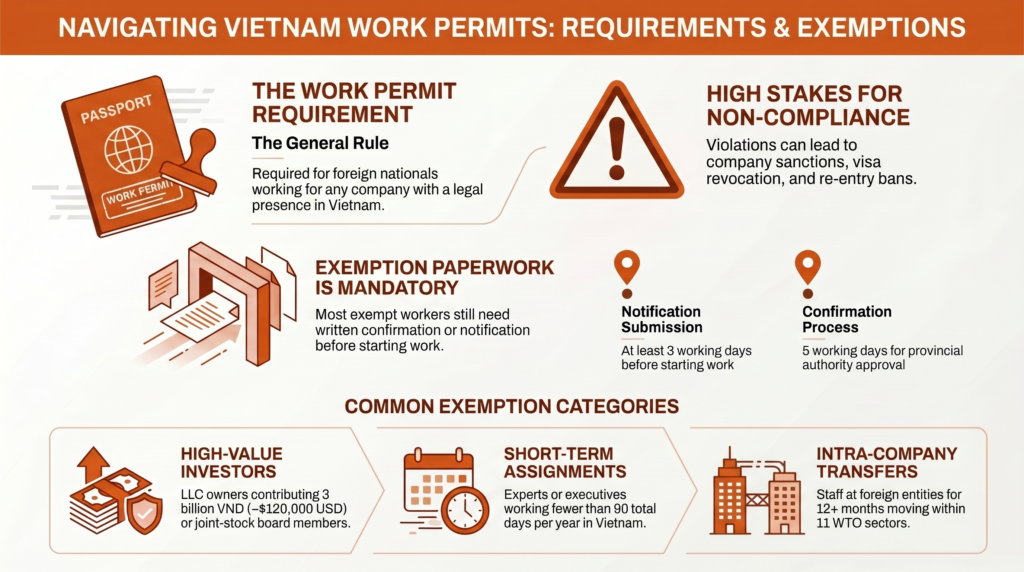
You do not need a work permit if you fall into one of the 15 exemption categories under Decree 219. The most relevant ones for people in standard employment situations:
- You are an owner or member of a Vietnamese LLC with a capital contribution of at least 3 billion VND (approximately 120,000 USD), or a board member of a joint-stock company at the same threshold.
- You are entering under an intra-company transfer within one of 11 WTO service sectors, your company has a commercial presence in Vietnam, and you have been employed by the foreign parent entity for at least 12 consecutive months before entering.
- You work less than 90 total days per year in Vietnam in a manager, executive director, expert, or technical worker role.
- You are responsible for establishing a commercial presence in Vietnam (a specific short-term category for pre-setup work).
- You work in priority sectors: finance, science and technology, innovation, national digital transformation and have written confirmation from the relevant ministry or provincial authority.
If you are not sure which category applies to you, assume you need a work permit and verify from there. Working without one is not a fine-and-continue situation. The company can be sanctioned, your visa can be revoked, and you can be banned from re-entry.
People often miss this: Falling under an exemption category does not mean there is no paperwork. Most exempt workers still need a written confirmation of exemption (giấy xác nhận không thuộc diện cấp giấy phép lao động) from the provincial authority, or at minimum a notification submitted at least 3 working days before starting work. The confirmation process runs 5 working days.
The Legal Basis: What Decree 219 Changed
Vietnam’s work permit framework is now governed solely by Decree 219/2025/NĐ-CP, effective August 7, 2025. It replaced Decrees 152/2020 and 70/2023 entirely.
Three changes that matter most for people going through this process now:
The labor demand report is no longer a separate step. Under the old system, employers submitted a standalone report to justify hiring a foreigner, waited for approval, then submitted the work permit application as a second, separate process. Decree 219 merged these. The justification and the permit request are now a single combined application (Form No. 03), reviewed together within one 10-working-day window.
Processing time is now 10 working days for the combined review, up from 5 working days under the old rules. The practical effect is similar total time, because the old 5-day window only started after the separate labor demand approval finished.
All authority now sits with the provincial People’s Committee (UBND cấp tỉnh). Under the old system, some cases went to the Ministry of Labor, others to provincial departments. Now everything goes to the provincial level, either through the local administrative services center or the national online public services portal.
The Four Work Positions (This Determines Your Document Requirements)
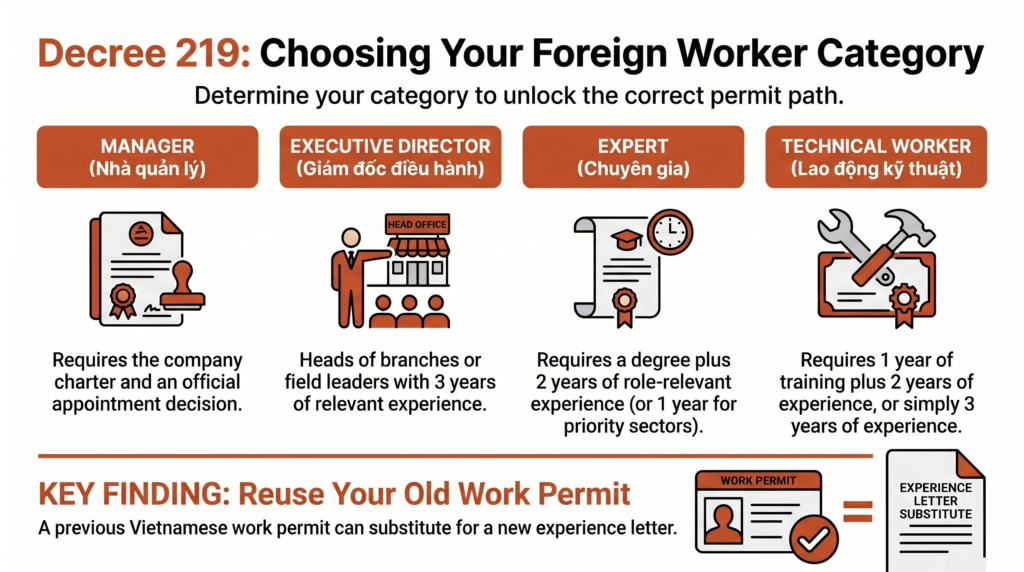
Decree 219 defines four types of positions for foreign workers. Which one applies to you determines what you need to prove.
Manager (Nhà quản lý) Manages an enterprise under the Enterprise Law, or heads/is deputy head of a department. Key documents: company charter + appointment decision.
Executive director (Giám đốc điều hành) Either the head of a branch, representative office, or business location — or someone who directly leads a specific field within an organization with at least 3 years of relevant experience. The experience requirement applies to the second type only.
Expert (Chuyên gia) Two paths under Decree 219:
- University degree or equivalent + at least 2 years of work experience relevant to the role in Vietnam, or
- University degree in the specific field + at least 1 year of relevant experience, if working in a designated priority sector (finance, technology, innovation, digital transformation, or other government-designated areas).
Important change from old rules: experience no longer needs to match the field of study. It needs to match the role. A mechanical engineering degree paired with 2 years managing software implementation can qualify, if the application is framed correctly.
Technical worker (Lao động kỹ thuật) Either: formal training of at least 1 year + 2 years of relevant experience or 3 years of relevant experience with no formal training requirement.
Useful in all categories: A previously issued Vietnamese work permit can substitute as evidence of work experience under Decree 219. If you have held a Vietnamese WP before, you do not need a separate experience letter.
What the Full Process Looks Like
Here is the process in the order things actually happen.
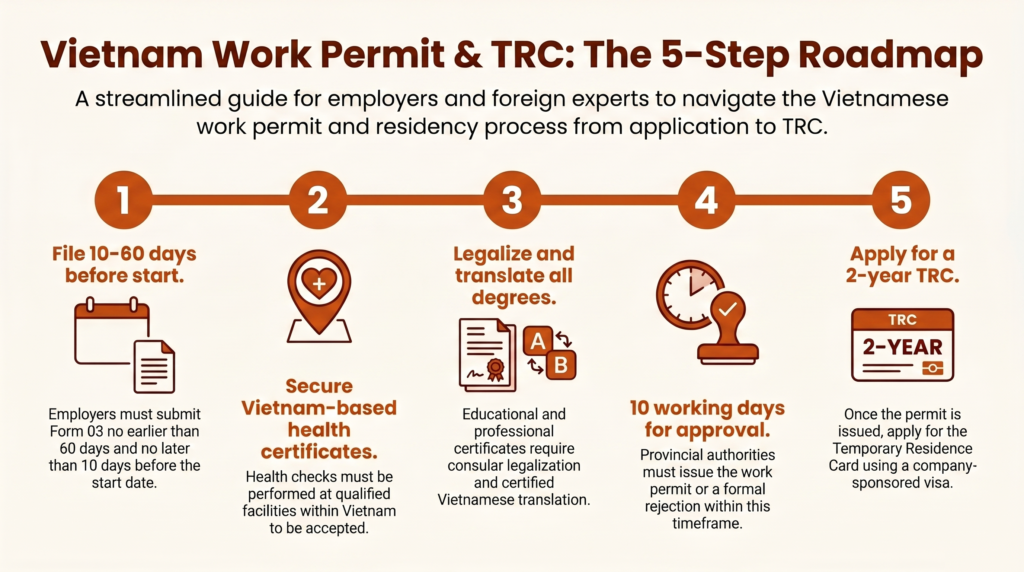
Step 1: Employer submits the combined application
The employer files the combined justification + permit request (Form No. 03) with the provincial administrative services center where you will work, or online via the national public services portal.
Timing: no earlier than 60 days and no later than 10 working days before your intended start date. Filing outside this window is a procedural problem that delays everything.
Step 2: Your personal documents (prepared in parallel)
- Criminal background check (Phiếu lý lịch tư pháp) or a foreign-equivalent document confirming no current criminal status. Must be issued within 6 months of the application date. Foreign documents require consular legalization. Under Decree 219, this can be requested simultaneously with the work permit through the online system if the employer files electronically.
- Health certificate: Must be issued by a qualified medical facility in Vietnam. Foreign-issued health certificates are generally not accepted in practice. The certificate must be valid within 12 months from the date of the health conclusion.
- Degree or professional certificate: Must be consular legalized (or apostilled if your country and Vietnam are both Hague Convention members) and translated into Vietnamese with a certified translation.
- 2 photos 4cm x 6cm, white background, looking straight, no glasses, taken within 6 months.
- Passport copy.
- Documents proving your position type: for expert or technical worker, this means degree plus work experience evidence; for manager or executive director, the company charter and appointment decision.
Step 3: Review and decision
Within 10 working days of receiving a complete application, the provincial authority either issues the work permit or issues a written rejection with stated reasons within 3 working days. No intermediate approval step.
Step 4: Enter on a valid visa, receive work permit, then apply for TRC
You need to be in Vietnam on a valid visa when the work permit is processed. Any Vietnamese visa type is generally accepted by the provincial labor authority. The Sở does not screen visa type as a condition for issuing the WP.
A note on practice: Some advisors recommend a business visa (DN) over a tourist visa (DL) as a precaution- particularly in provinces outside Hanoi and Ho Chi Minh City where local practice can vary. If you have the option, a DN visa sponsored by the employer avoids any ambiguity.
Step 5: TRC application
The Temporary Residence Card (thẻ tạm trú) is a separate process from the work permit. To apply, you need:
- A valid work permit, and
- A visa sponsored (bảo lãnh) by the same company that holds the work permit.
This does not have to be an LD2 labor visa. A DN visa sponsored by the employing company is sufficient in most cases. Other visa types may also be workable depending on the situation. The key is that the sponsoring entity on the visa matches the employer on the work permit.
TRC processing: 10 to 20 working days, valid for up to 2 years (matching the work permit duration).
Timeline in Practice
| Stage | Official timeframe | Realistic timeframe |
|---|---|---|
| Document preparation (your side) | Parallel with Step 1 | 2–4 weeks if overseas legalization needed |
| Combined WP application + review | 10 working days | 10–15 working days |
| TRC application | 15 working days | 15–25 working days |
Total from starting document collection to TRC in hand: 45 to 60 working days if you begin early and nothing requires rework. Closer to 75 to 90 days if documents need legalization from abroad.
The single biggest delay factor is degree legalization. If your degree was issued in a country with a multi-step legalization process (not a Hague Convention member), or a member where local offices add steps, start before you accept the offer, not after.
What Gets Applications Rejected
Rejections are not random. The failures cluster around five specific problems.
1. The labor justification is too generic. The combined application requires a real explanation of why this role cannot be filled by a Vietnamese national. “We need someone with international experience” does not work. The explanation needs to reference specific technical skills, language requirements, or specialized knowledge that makes local hiring inadequate. Weak justifications are the most common cause of rejection under Decree 219.
2. The degree is not properly legalized. A notarized copy is not the same as a consular-legalized document. A certified translation is not the same as a translation attached to a legalized original. Vietnam is specific about which steps count. Submitting a partially legalized document often produces a rejection rather than a request for more information.
3. The work experience documentation does not match the declared position. If the application says “expert in financial services” but the supporting documents show a general management background, the reviewing authority will ask for clarification. Letters from previous employers should specify the role, responsibilities, and level of relevant decision-making. Generic employment confirmation letters are often insufficient.
4. The health certificate was issued outside Vietnam. The authority requires a Vietnamese-issued health certificate from a qualified facility. A health check from your home country, even from a major hospital, will not be accepted. Get this done in Vietnam before or shortly after arriving.
5. The employer’s legal documentation is not current. If the employer’s business registration certificate is expired, or if the company recently changed its charter capital without updating the registration, the authority will return the application. This is entirely the employer’s responsibility, but applicants rarely think to verify it before the process starts.
Renewal: What the Rules Say
Work permits under Decree 219 can be extended once, for a maximum of 2 additional years. The extension uses the same Form No. 03 and the same 10-working-day review window.
The extension window: no earlier than 45 days before the permit expires, and no later than 5 days before expiry. If the permit has already expired, extension is not possible, the employer must apply for a new permit from scratch.
Start the extension process at least 45 days before expiry. For documents requiring overseas legalization, start earlier.
What This Process Does Not Cover
A work permit is not a visa. It does not let you stay in the country. You need a valid visa or TRC at all times.
A work permit is employer-specific. It names one employer. Changing jobs requires a new work permit. There is no transfer mechanism.
A work permit has a maximum duration of 2 years, followed by one possible extension of up to 2 years. After that, a new permit is required.
Family members have separate requirements. A work permit does not extend to spouses or children. Dependents on family visas follow a different process.
Before You Start: Three Things to Confirm With Your Employer
Before either party spends time on documents, confirm these three things with HR or the company’s legal team:
1. Has the company hired foreigners under Decree 219? The new combined application format is different from the old two-step process. First-time employers sometimes need guidance on how to write the justification component – the section that most often causes rejection.
2. When does the employer plan to submit the application? The window is 10 to 60 days before your start date. If HR does not have a specific submission date in mind, the process has not actually started.
3. Is the company’s business registration current? Ask to see the certificate. Verify the name, registration number, and validity date match what will appear on the application.
These three questions take 10 minutes and will tell you more about your actual timeline than any government website.
Getting Help
Work permit applications under Decree 219 are not complicated in the sense that any individual step is hard. They are complicated in the sense that there are many steps, they happen in a specific order, and a mistake in the justification document does not become visible until the review window is nearly over.
If you want someone to walk through your specific situation before committing to a start date with your employer, Rita offers an initial consultation where she reviews your documents and employment setup and gives you a realistic timeline. No generic estimates.
If you are ready to proceed and need full-service handling from the application through TRC issuance, that’s covered under the New Arrival Package.
Last updated: August 2025. Reflects Nghị định 219/2025/NĐ-CP (effective 07/08/2025) and Bộ luật Lao động 45/2019/QH14. Processing standards may vary by province.

I advise foreigners living and working in Vietnam on legal matters. Most of my clients come to me after something has already gone wrong, so I focus on helping them understand the rules early, before problems start.