Updated April 2026 to reflect Decree 96/2026/NĐ-CP, the implementing regulation for Vietnam’s new Investment Law 2025. Most guides online have not caught up yet. This one has.
Most guides about registering a company in Vietnam tell you what forms to file. This one tells you what actually goes wrong, what changed in 2026, and when you should think twice before starting.
If you’re a foreign investor or founder planning to enter Vietnam, this is the reference page. Read it before you talk to a lawyer. It will save you time, and probably money.
Before you register: the real question
Registering is the easy part. The harder question is whether your business model, your capital, your timeline, and your industry actually fit the Vietnamese regulatory framework.
I’ve seen foreign founders spend weeks preparing documents for a structure that wasn’t available to them in the first place. The restriction list exists. Some industries require local partners. Some are closed to foreign capital entirely. Some are open on paper but require a separate operating license that adds months to the process.
Know which category you’re in before you pick an entity type.
What changed in 2026: Decree 96
On March 31, 2026, the Vietnamese government published Decree 96/2026/NĐ-CP, the implementing regulation for the new Investment Law 2025.
Five changes in this decree directly affect foreign founders:
The issuing authority is new. The Department of Planning and Investment has merged into the Department of Finance at the provincial level. For most projects outside special zones, your Investment Registration Certificate (IRC) now comes from the Department of Finance. Inside industrial zones, export processing zones, and high-tech zones, the zone’s Management Board still handles it. File with the wrong office and your application is returned without processing.
The registration sequence is now your choice. Under the previous system, foreign investors had to obtain the IRC first, then incorporate under the ERC. Article 72 of Decree 96 introduces a new path: incorporate first, complete the IRC within 12 months. Both methods are legal. You choose. More on this below.
Charter capital and project capital are decoupled. Before, these two figures were typically required to match. Now your registered shareholder capital can be different from the capital you commit to a specific project. This gives you more room to structure investment flow over time.
One company can run multiple projects. A single foreign-invested company can now hold multiple registered business lines and use them for separate projects, each with its own IRC. Under the old system, this typically required separate corporate vehicles.
A fast-track procedure exists for designated zones. Projects in industrial zones, export processing zones, high-tech zones, free trade zones, and international financial centers can access a streamlined process that bypasses several normally required permits. More on this below.
The two main entity types
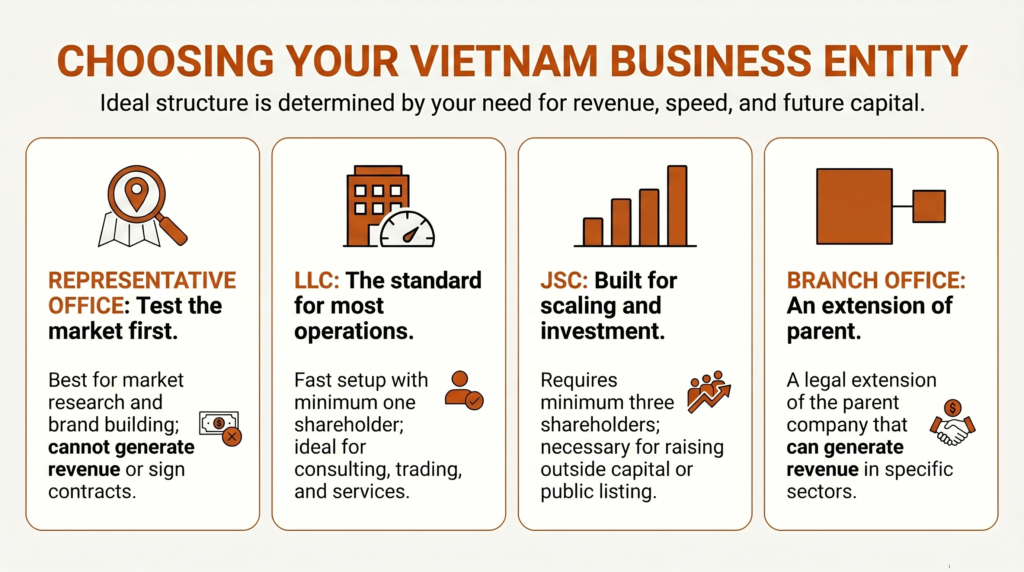
Most foreign investors entering Vietnam choose between two structures:
Limited Liability Company (LLC / Công ty TNHH). Minimum one shareholder. Works well for consulting, trading, services, and most small-to-mid-size operations. Simpler governance. Faster to set up.
Joint Stock Company (Công ty Cổ phần). Minimum three shareholders. Required if you plan to raise investment from multiple parties or eventually list on a securities exchange. More administrative overhead, but the right structure if your growth path involves outside capital.
There are two other options worth knowing:
Representative Office. Not a company. Cannot generate revenue or sign commercial contracts. Used for market research, supplier coordination, and brand building while you decide whether to fully commit. The fastest and cheapest way to establish a legal presence without the full setup.
Branch Office. A legal extension of the parent company. Can generate revenue. More restricted than a fully incorporated entity. Used in specific sectors.
If you’re still testing the market, a Representative Office is often the right first step. If you’re ready to operate, you’re choosing between LLC and JSC.
Who can actually own 100%?
Foreign ownership is unrestricted in most industries. But not all.
Vietnam maintains a list of sectors with conditions on foreign participation. These fall into three categories:
Fully restricted. A small number of activities are closed to foreign investment entirely.
Conditionally open. Many sectors allow foreign investment but with caps on ownership percentage, requirements for Vietnamese partners, or additional licensing. Common examples include certain types of education, healthcare, media, and financial services.
Open with additional licensing. Some sectors allow 100% foreign ownership but require operating licenses on top of the standard IRC and ERC. Food service, retail, childcare, and certain professional services fall here. The license adds time, sometimes several months.
The practical check. Your sector is identified by its Vietnam Standard Industrial Classification (VSIC) code. You map your intended activities to a code, then check that code against Vietnam’s market access commitments under WTO and the current Negative List. Your advisor should do this for you. If they don’t, ask.
The sectors I see most commonly misunderstood: language schools, co-working spaces, e-commerce platforms, food delivery operations, and fintech. Each has specific conditions that are not obvious from the business description.
Should you go 100% foreign or use a local company structure?
This is the question most guides skip. It matters more than most foreign investors realize.
What is a “local company” in this context?
A local company (công ty nội địa) is one where foreign ownership is below 51%. When the foreign ownership stake stays under that threshold, Vietnamese law treats the company as a domestic entity, not a foreign-invested enterprise (FIE). That difference in classification has practical consequences.
When the local company structure is worth considering:
Your sector has a foreign ownership cap. Some industries certain types of retail, education, media, travel agencies,… either prohibit 100% foreign ownership or make it operationally difficult. If you’re entering one of those sectors and you have a Vietnamese partner you trust, structuring below 51% opens doors that are closed to a fully foreign-owned entity.
Speed matters more than control. A local company does not need an IRC. It goes straight to the Enterprise Registration Certificate. The setup timeline drops from 8 to 14 weeks (for a 100% FIE) to roughly 5 to 7 working days. If you’re trying to sign contracts or hire staff immediately, the time difference is significant.
Your industry has no clear regulatory framework. Some sectors: co-working, online education platforms, certain wellness services fall into grey zones where 100% foreign-owned companies face ambiguous approval processes. A local company structure sometimes sidesteps this ambiguity, because domestic companies are subject to clearer, simpler rules.
The trade-offs you need to understand:
The speed and access advantages come with real costs. A Vietnamese partner holding 49% or more of your company is a partner in every legal sense. Governance documents matter. Shareholder agreements, voting rights, dividend terms, and exit mechanisms need to be drafted carefully before you start – not after a dispute arises.
I’ve seen local company structures work well when the partner relationship was thought through from the beginning. I’ve also seen them become the most expensive decision a founder made in Vietnam, when the partnership was treated as a paperwork formality rather than a real legal relationship.
The honest summary: if your industry allows 100% foreign ownership and you don’t have a Vietnamese partner you genuinely trust with significant equity, the 100% FIE route is simpler and gives you full control. If your sector has restrictions, or speed is genuinely critical, the local company structure deserves a serious conversation before you decide.
Method 1 vs. Method 2: the 2026 registration sequence
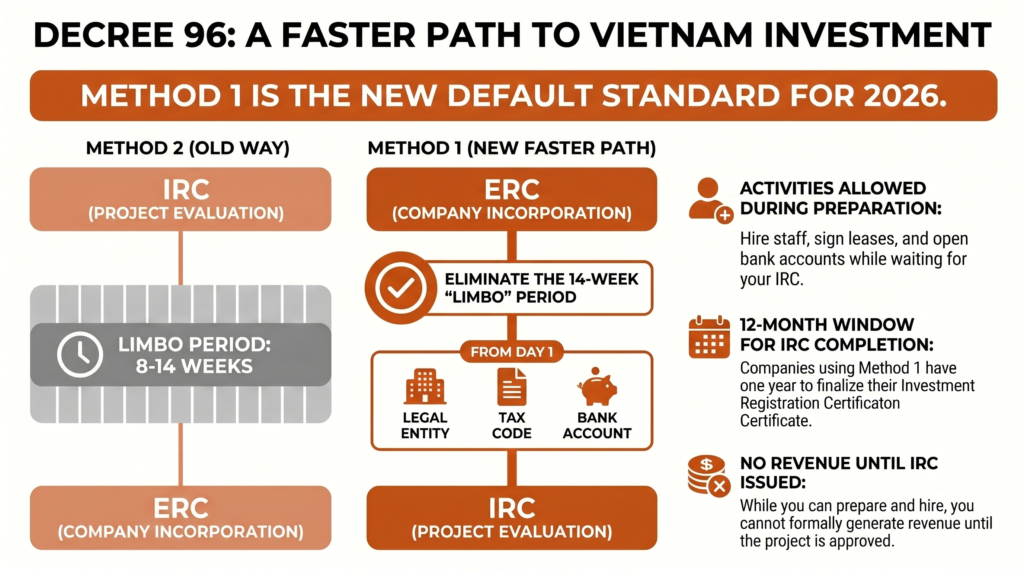
This is the most significant practical change in Decree 96, and it affects how you structure your entire setup timeline.
Method 2 (the traditional path).
Apply for the IRC first. The issuing authority evaluates the project. If approved, incorporate the company and receive the ERC. The company can then operate.
Timeline: typically 8 to 14 weeks for the IRC, then 5 to 7 days for the ERC. During the entire IRC period, you have no legal entity, no bank account, no contracts, no employees. You’re waiting.
Method 1 (the new path, introduced by Article 72 of Decree 96).
Incorporate the company first. Receive the ERC. You then have 12 months to complete the IRC. The company exists legally from day one. It has a tax code, can open bank accounts, can sign contracts, and can hire employees. It cannot formally operate the investment project until the IRC is issued, but it can do everything needed to prepare.
The practitioners I work with and trust on this question are recommending Method 1 as the default for most foreign projects in 2026. The reasoning is straightforward: Method 2 left investors in limbo for 10 to 14 weeks with no legal entity to work with. Method 1 eliminates that problem.
What you can do during the 12-month window under Method 1:
- Sign employment contracts
- Rent premises and sign lease agreements
- Open a standard corporate bank account
- Register for tax
- Negotiate with customers, suppliers, and partners
- Import equipment (with coordination on customs documentation)
What you cannot do:
- Formally generate revenue from the investment project before the IRC is issued
- Add new business lines in ways that expand the project scope before the IRC is granted
For most founders, the 12-month window is spent on preparation anyway. Equipment, team, systems, and pipelines all take time regardless of which method you use.
When Method 2 still makes sense.
If your project requires investment policy approval (chấp thuận chủ trương đầu tư) typically large projects with significant land use, sensitive sectors, or projects requiring national-level review, the sequence matters less because you go through that review regardless. If your industry classification is genuinely ambiguous and you want the authority to settle it before you commit setup costs, IRC-first gives you that answer first.
One important caveat. As of this writing, the implementing circular that will govern how Method 1 is processed in practice has not been issued. Decree 96 is in force, but the operational playbook is still being written. Expect timelines and specific form requirements to be refined when the circular appears, likely in the second half of 2026.
For a full breakdown of how to choose between Method 1 and Method 2, including the M&A implications and what “cannot formally operate” actually means in practice, read the detailed analysis here: Vietnam’s Foreign Investment Rules Just Changed. Here’s What Actually Matters.
The registration process, step by step
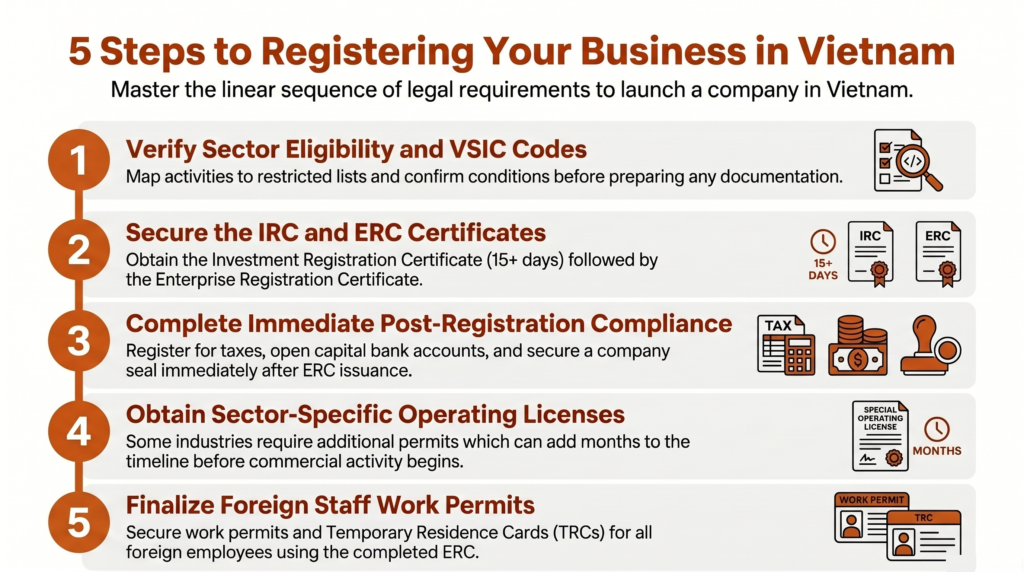
Step 1. Confirm your sector eligibility.
Map your intended activities to VSIC codes. Check against the restricted and conditional sector list. If there are conditions, understand what they are before proceeding. This step should happen before anything else.
Step 2. Choose your entity type and registration method.
LLC or JSC. Method 1 (ERC first) or Method 2 (IRC first). These decisions affect your timeline and your operating flexibility from day one.
Step 3. Prepare your application dossier.
For the IRC: passport copies of investors, proposed company charter, business description with VSIC codes, proof of financial capacity (varies by project), proposed location.
For the ERC under Method 1: similar documents, plus the company charter, information about legal representatives.
Documents in a foreign language require notarized translation into Vietnamese.
Step 4. Investment Registration Certificate (IRC).
Under Method 2: file with the Department of Finance (for most provincial projects) or the zone’s Management Board (for projects in industrial/tech zones). Official timeline is 15 working days. Real timeline with revision requests: 8 to 14 weeks in 2026, possibly longer during the Department of Finance transition period.
Under Method 1: this step comes after the ERC, within a 12-month window.
Step 5. Enterprise Registration Certificate (ERC).
Under Method 2: filed after the IRC, typically 3 to 5 working days.
Under Method 1: filed first, typically 3 to 5 working days.
Step 6. Post-registration compliance.
Tax registration (required immediately upon ERC issuance). Company seal. Opening a standard corporate bank account. If deploying foreign capital: the foreign direct investment capital account (tài khoản vốn đầu tư trực tiếp nước ngoài). Labor registration. Social insurance registration once you hire employees.
Step 7. Sector-specific licenses (if required).
Some industries need additional operating permits before you can begin commercial activity. This step can add anywhere from 4 weeks to several months depending on the sector and the issuing authority.
Step 8. Work permits, visas, and residence cards for foreign staff.
If you or your foreign employees will be working in Vietnam, the company registration is not the end of the process. Foreign nationals working at a Vietnamese-registered company need a work permit (giấy phép lao động), and most then apply for a Temporary Residence Card (TRC) to avoid managing 90-day visa cycles. The work permit process requires the company to be properly registered first, so the ERC is a prerequisite, not a parallel track.
This is a step many founders underestimate in terms of timeline and documentation. A full guide to the work permit and TRC process for foreign employees is here: Work Permit in Vietnam: The Complete Guide for Expats (2026)
Charter capital: what you actually need to know
Charter capital is the amount you declare as shareholder capital in the company charter. It is not the total investment you’re committing to a project. Under Decree 96, these two figures can now be different.
A few things most guides don’t mention:
There is no universal minimum. Except for regulated sectors (banking, securities, real estate development, and a few others), Vietnam does not set a minimum charter capital for most businesses. You can technically declare VND 100 million. In practice, your charter capital signals credibility to banks, partners, and licensing authorities. Very low charter capital creates friction.
You have 90 days to actually transfer the capital. The charter capital you declare must be transferred into the company’s capital contribution account within 90 days of the ERC being issued. Failure to transfer on time requires you to reduce the declared capital through a formal amendment process.
Declaring too low causes problems later. I’ve seen clients set charter capital at the minimum to reduce registration fees, then find they can’t get the sector license they need (which requires a minimum capital threshold), can’t borrow from banks (which use charter capital as a proxy for creditworthiness), or have to go through an amendment process that costs more time and money than the original saving.
Set your charter capital at a level that reflects what you actually intend to deploy in the first 12 to 24 months.
The special investment procedure (if your project is in a designated zone)
If your project goes into an industrial zone, export processing zone, high-tech zone, concentrated digital zone, free trade zone, international financial center, or a functional zone within an economic zone, Articles 46 to 50 of Decree 96 give you access to a different process.
Under the special procedure, several normally required permits are replaced with a written commitment:
- Environmental impact assessment
- Fire prevention and safety approval
- Construction permit
Instead of obtaining each of these before filing, you submit a written commitment to meet the relevant standards. The zone’s Management Board grants the IRC within 15 working days. Compliance is verified after, not before.
This is a real change. Under the old system, obtaining fire safety approval alone could take 6 to 10 weeks for a manufacturing facility. The special procedure compresses that significantly.
Two things to know before assuming this applies to you. First, the special procedure is only available for projects that don’t require investment policy approval (chấp thuận chủ trương đầu tư). Large projects with significant land use or sensitive sectors still go through that review. Second, “verified after” means inspections will happen. The commitment is legally binding. If your facility doesn’t meet the standards when inspected, operations can be suspended and penalties are significant.
For tech companies, R&D centers, and light manufacturing in eligible zones, this is a meaningful opportunity. For projects with environmental complexity, evaluate carefully.
Common mistakes I see
Getting the entity type wrong upfront. Switching from an LLC to a JSC after incorporation is possible, but it requires a formal conversion process and additional time. Decide based on your actual 3 to 5 year plan, not on what’s fastest to set up.
Not checking sector restrictions before signing anything. I’ve had clients who signed a preliminary lease or paid a consultancy retainer before discovering their intended industry classification required either a Vietnamese partner or a separate operating license. That’s an expensive way to find out.
Underestimating the Department of Finance transition. The merger from DPI to Department of Finance happened March 31, 2026. The new staff are still calibrating. In 2026, expect longer timelines, more requests for supplemental documents, and wider variation between provinces. Budget extra time.
Missing the 90-day capital transfer deadline. The charter capital declared in your ERC must be transferred within 90 days. This sounds simple. It gets missed more often than you’d expect, especially when banking setup takes longer than anticipated.
Not testing the bank early. Under Method 1, confirm with your target bank that they will open the foreign direct investment capital account under Method 1 conditions before you assume it’s automatic. Some banks are still calibrating their internal procedures for the new sequence.
Treating the IRC as the finish line. The IRC covers your investment. It does not cover your data handling obligations under the Personal Data Protection Law 2025, your intellectual property registration, your import and export licenses (if applicable), or your labor compliance. Each has its own regime.
Conditional logic: which path fits your situation
If you’re testing the market before committing: Consider a Representative Office first. It’s faster, cheaper, and gives you a legal presence while you assess.
If your sector has no foreign ownership restriction: Default to Method 1 under Decree 96. Incorporate first, get operational, complete the IRC within 12 months.
If your sector is on the conditional list: Get a legal opinion on the specific conditions before choosing your structure. The conditions vary significantly between sectors.
If your intended industry has ownership caps or ambiguous regulatory status: Consider whether a local company structure (below 51% foreign ownership) opens options that are unavailable or slower under a 100% FIE structure. This requires a Vietnamese partner and careful governance documentation.
If your project goes into an industrial or tech zone: Check whether the special investment procedure under Articles 46 to 50 applies. If it does, your IRC timeline is potentially 15 working days instead of months.
If you’re entering Vietnam through acquisition rather than a new setup: Method 1 is particularly useful. You can incorporate the corporate vehicle without first designing a placeholder project. The acquired project’s IRC is then transferred to your new company through the standard procedure.
If your industry requires a sector license in addition to the IRC and ERC: Build that license timeline into your overall plan. It often runs in parallel with the post-ERC period, but some licenses take significantly longer than others.
If you’re not sure which method is right for your specific project: That’s the conversation to have with a legal advisor before you file anything.
What I do, and what I don’t
I help foreign investors and business owners navigate the legal side of setting up in Vietnam: structuring the right entity, preparing and submitting registration documents, handling sector-specific licensing, and advising on the conditions that apply to specific industries.
I work with clients who have done their research and want someone accountable, not just someone who will forward documents.
I don’t handle ongoing accounting, tax filing, or HR payroll processing. For those, I can refer you to people I trust.
Before you contact me: a checklist
If you’re ready to talk, having answers to these questions ready will make our first conversation more useful:
- What industry are you in? (As specific as possible. VSIC code if you know it.)
- Do you want to own 100%, or do you have a Vietnamese partner?
- Have you identified a province or location for your registered address?
- What’s your approximate charter capital intention?
- Do you need to hire employees from day one, or is that a later step?
- What’s your target date to be operational?
You don’t need answers to all of these before reaching out. But the more specific you can be, the faster we can get to what actually matters for your situation.
Rita Ngo is a legal consultant advising foreign investors and expatriates in Vietnam. Most of her clients come to her after something has already gone wrong – which is why she focuses on helping people understand the rules early.
Related: Vietnam’s Foreign Investment Rules Just Changed. Here’s What Actually Matters. A detailed breakdown of Decree 96/2026 for founders making entry decisions in 2026.

I advise foreigners living and working in Vietnam on legal matters. Most of my clients come to me after something has already gone wrong, so I focus on helping them understand the rules early, before problems start.